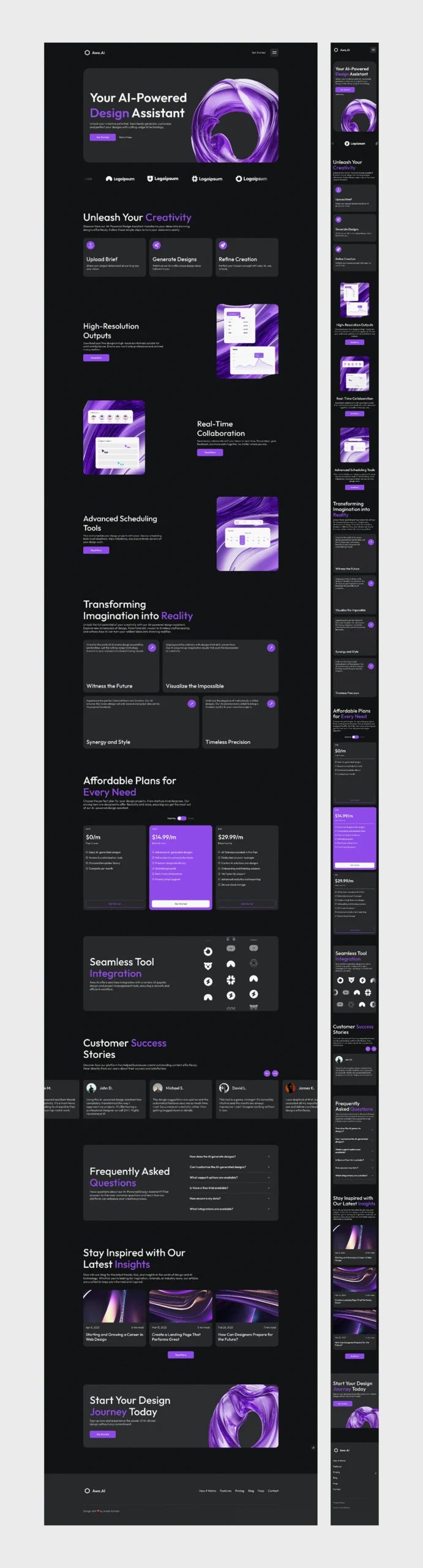
Aven AI is a conceptual AI-powered design assistant platform created to help designers and teams generate, refine, and collaborate on designs using intelligent automation. The goal of this project was to translate advanced AI capabilities into a visually striking, modern, and highly usable SaaS interface that feels premium, innovative, and trustworthy.
The design focuses on guiding users from discovery to conversion while clearly explaining AI-driven features without overwhelming them.
Objectives
- Create a premium AI SaaS landing experience with a strong first impression
- Clearly communicate AI-driven design workflows and capabilities
- Highlight collaboration, automation, and productivity features
- Encourage sign-ups through pricing clarity and strong CTAs
- Build a scalable layout suitable for future AI tools and modules
Roles & Responsibilities
- Designed the complete landing page UI from concept to final delivery
- Defined user flow from hero section to pricing and onboarding CTAs
- Designed modular feature sections explaining AI-powered workflows
- Created pricing tables with clear hierarchy and comparison
- Designed testimonial, FAQ, and blog sections for trust and engagement
- Established a consistent dark-theme design system with accent colors
- Ensured responsive-friendly layout structure for scalability
Design Scope / Sections
- Hero Section & Value Proposition
- AI Workflow Steps (Upload, Generate, Refine)
- Feature Highlights & Visual Demonstrations
- Collaboration & Productivity Sections
- Pricing Plans & Comparisons
- Tool Integrations
- Customer Success Stories
- FAQs & Blog Highlights
- Final CTA & Footer
Design Approach
- Dark SaaS Aesthetic: High-contrast UI with purple accent tones
- AI-Centric Visuals: Abstract graphics and motion-inspired layouts
- Clear Information Flow: Gradual explanation from concept to value
- Conversion-Focused Layout: Strategic CTA placement throughout
- Modular System: Reusable components for future feature expansion
Key UX Focus Areas
- Simplifying AI workflows for non-technical users
- Clear pricing and value differentiation
- Visual hierarchy for long-form SaaS content
- Trust-building through testimonials and FAQs
- Seamless transition from exploration to action
Tools & Technologies
- Figma (UI Design & Prototyping)
- Adobe Illustrator (Icons & Visual Assets)
- Adobe Photoshop (Image Optimization)
- Miro (UX Planning & Content Structure)
Outcome
The final design delivers a polished, futuristic AI SaaS landing page that balances visual impact with usability. It effectively communicates complex AI functionality through clear structure, strong visual storytelling, and conversion-driven design—making it suitable for modern AI startups and enterprise SaaS products.